Player Safety Council / League directors
League directors
For League and Rec Directors: One Heat Plan Across Every Team
Volunteer coaches cannot invent a cooling plan on a Saturday morning. Site managers cannot guess who calls 911. That policy lives with you. Your job is one shared plan across every team, every field and every sport your league runs — before the first hot week, not after someone goes down.
What only league leadership can set
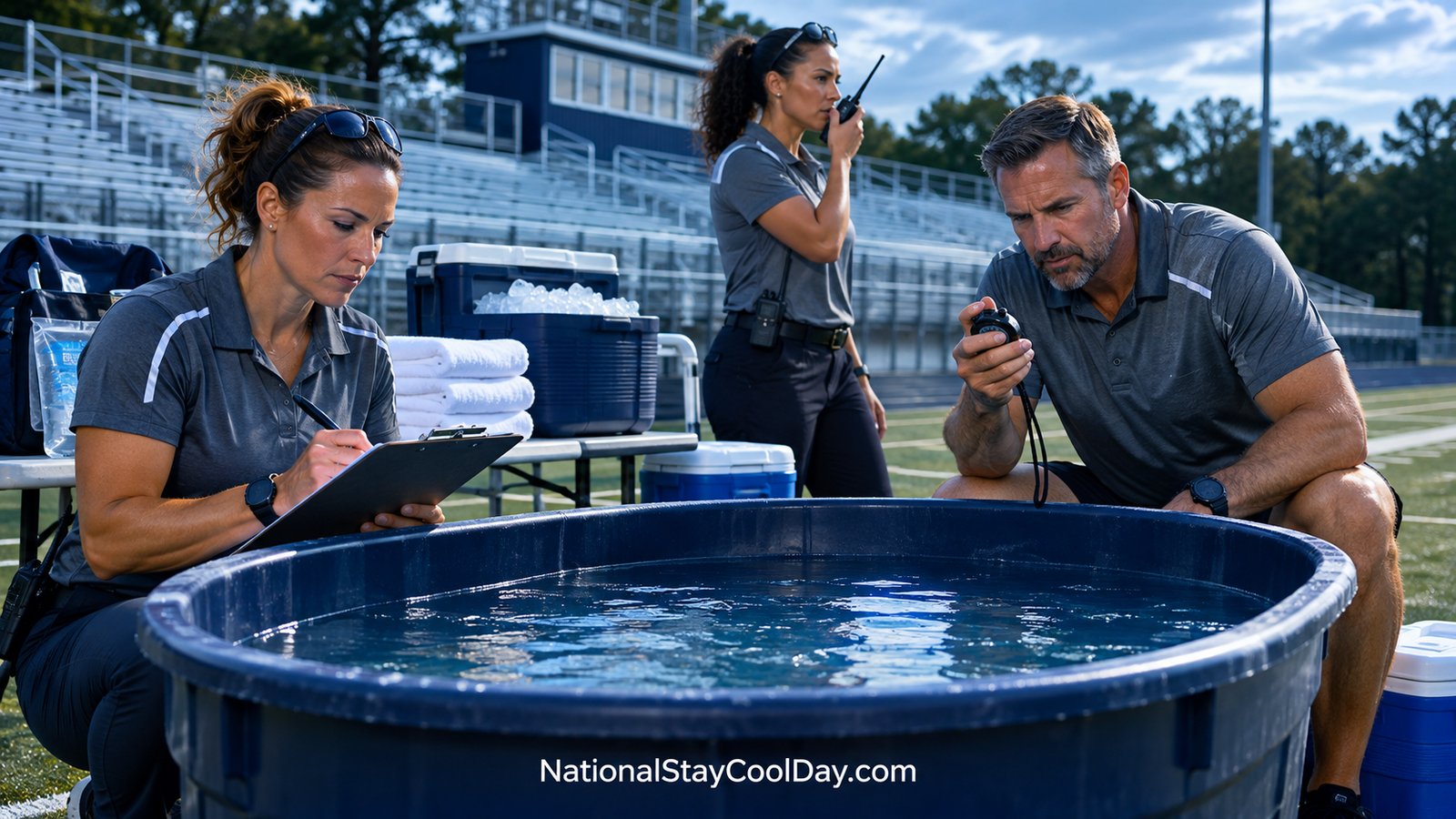
- Require cooling at every site. Every field or complex where your teams practice or play needs a way to do cold-water immersion on site: a tub or other container big enough for an athlete, water, ice and a clear place to put it. One tub locked in a shed across the complex is not ready.
- Say coaches may stop without calling up. Write it into the league handbook. Coaches and site managers should never wait for a board call-back to shorten, move or cancel a hot session.
- Require a written plan per venue. Address, ambulance entrance, AED location, shade and where the cooling tub sits. Any venue can build a free, printable plan with the National Stay Cool Day EAP builder.
- One shared emergency order for every team. Same warning signs, same steps, same cool-first rule.
- Cover every sport and age group the league runs. Football, soccer, baseball, softball, lacrosse, cheer, flag and younger divisions all use the same heat. Make the plan league-wide, not sport-by-sport.
Before the first hot week
- Confirm a tub and ice are ready at each field or complex, not stored "somewhere" for game day only.
- Confirm every site knows the street address, ambulance entrance and AED location. Write them into the venue plan.
- Name the roles for a hot session: who calls 911, who starts cooling, who meets EMS.
- Share the coaches heat routine with every head coach and the parents guide with every family before opening day.
- Walk each complex once with the preseason venue walkthrough so site managers see the same checklist.
During a hot weekend or tournament night
- Restock ice between sessions. Empty coolers do not count as a plan when games stack up.
- Keep radios or charged phones with every site manager.
- Empower site managers out loud: they can stop, shorten or move a game for heat without waiting for you.
- Watch the schedule. Back-to-back games and long waits in the sun add up. Build shade, water and rest into the day.
Warning signs
An athlete with exertional heat stroke may not look like they're in danger at first. Watch for an athlete who:
- seems confused, dizzy or out of it,
- is acting strange, irritable or not like themselves,
- stumbles, can't keep up, or can't follow simple directions,
- collapses or goes down during or after hard play in the heat.
Any change in how an athlete thinks or acts during hard play in the heat should be treated as heat stroke until proven otherwise.
If an athlete goes down
Exertional heat stroke is 100% survivable when the athlete is cooled fast, on site. Every adult on the sideline should know this order:
- Call 911 and start cooling at the same time. One person calls. Everyone else works on cooling.
- Get the athlete into cold water. Cold-water immersion with ice agitation is the standard. Cooling should start within 10 minutes.
- Keep cooling. The goal is about 102°F within 30 minutes. At 104°F the body loses its ability to regulate its own temperature, so it can't cool itself down.
- Cool first, transport second. Don't load the athlete into a car or ambulance before cooling has been done.
- Remove anything you can quickly but don't delay cooling because of gear removal.
After a heat incident / end of season
- Document what happened, when cooling started and what you would change next time.
- Share the fix with every team, not only the one that had the problem. A gap at one field is a league gap.
- Ask coaches and site managers what worked and what didn't. Update the handbook before next summer.
- Make sure new coaches get the same heat training as returning ones.
Where to go next
Share the coaches page and the parents page across the league. Use the preseason venue walkthrough at every complex. Club and travel programs can start with the club directors page; school programs with the athletic directors page. Build or refresh a venue plan with the EAP builder. For questions about the Council, contact us.