Player Safety Council / Principals
Principals
For Principals: Your Part in Your School's Heat Safety Plan
You don't need to know every practice schedule or every drill. You need to know that the plan exists, that someone owns it, and that nothing on your campus slows it down when a student collapses on a hot afternoon.
Know who owns the plan
- Ask your athletic director for the school's written heat policy and read it once. Our page on writing a heat policy shows what it should cover.
- Know who your heat safety lead is, and who backs that person up.
- Ask where the emergency action plan for each practice site is posted, and when staff last practiced it.
- Make sure the school nurse and the athletic staff have talked about who does what. The school nurse page can help start that talk.
Clear the way for help to get in
When someone calls 911 from a practice field, the ambulance still has to find the athlete. Small things on a campus can cost time.
- Know which gates lock after school, who has the keys, and whether coaches can open them.
- Make sure every practice site has an address or clear directions that a caller can give to dispatch.
- Decide who meets the ambulance at the entrance and walks the crew to the athlete.
- Invite your local EMS to walk the campus before the season. Our page for EMS and first responders explains what they look for.
Make sure the cooling setup has what it needs
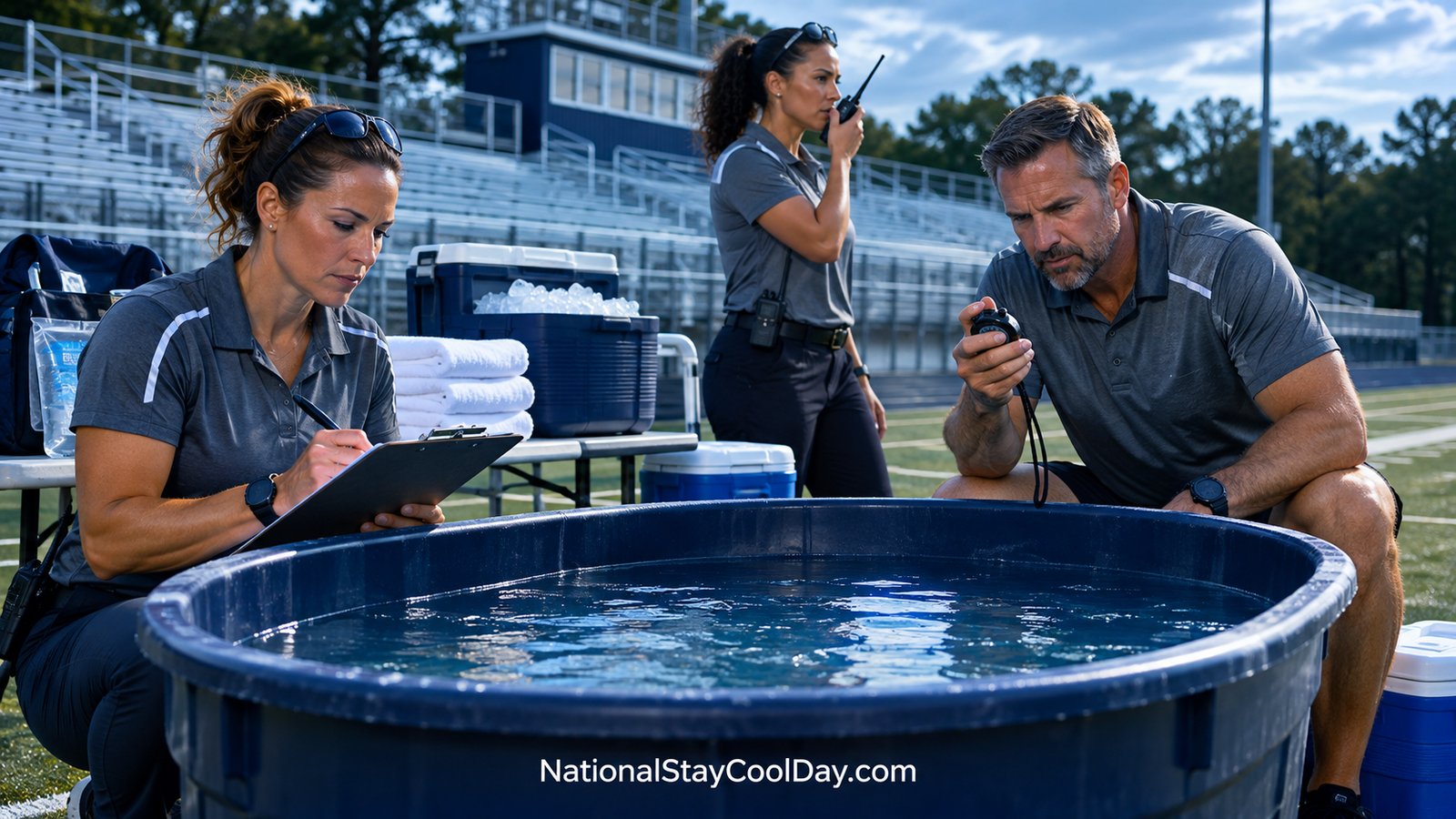
- A cooling tub, water, ice, towels and shade should be ready at every practice site before athletes start.
- Coaches need access to the ice machine or freezer after the building empties out, on weekends and during the summer.
- Know who fills the tub and brings the ice each day, and who checks that it happened.
- If the cost of ice and cooling gear falls on each coach, ask whether it can come from the school instead.
The emergency steps every principal should know
Exertional heat stroke is 100% survivable when cooling starts fast, on site. You may never be the one at the tub, but everyone on your staff should know that the right response is to:
- Call 911 and cool at the same time. One person calls while others start cooling.
- Start cooling within 10 minutes. Cold water with ice agitation, with the goal of about 102°F within 30 minutes. At 104°F the body loses its ability to regulate its own temperature.
- Cool first, transport second.
- Gear: remove anything you can quickly but don't delay cooling because of gear removal.
Back your staff when they follow these steps. Cooling on site before transport is the plan, not a delay.
After school, summer and the days the building is closed
Many of the hottest practices happen when the building is nearly empty. Summer workouts, early preseason and Saturday events can run with no office staff on site.
- Know which teams are on campus in the summer and who is in charge of each session.
- Make sure the custodial and after-hours staff know where practices are and how to help in an emergency.
- Check that phones work at every practice site, and that coaches have a way to reach an administrator after hours.
Help the message reach families
The front office often sends the messages families read most. Ask that heat updates, practice changes and the school's heat plan go out through the same channels. The heat communication plan lays this out, and heat safety in every language covers families who need the message in another language.
If something happens
A heat emergency affects athletes, families and staff long after the ambulance leaves. Our page on what to do after a heat emergency covers the days that follow.
A quick check for school leaders
- Do I know who our heat safety lead is?
- Can an ambulance get to every practice site after school without waiting on a locked gate?
- Can coaches get ice when the building is closed?
- Does my staff know the emergency steps above?
- Have families heard our heat plan from the school?
Where to go next
Your athletic director can use the heat season checklist to put this in place across every team, and the preseason venue walkthrough will help you check each field. For questions about the Council, contact us.
Take the next step: build your heat emergency action plan with the free National Stay Cool Day heat safety tools, then sign up your school for National Stay Cool Day on April 8, 2027. Both are free.